Patrice ChanceHEALTHCARE OPERATIONS LEADER
Let’s Connect ↗

IMPLEMENTATION CASE STUDIES

From requirements to adoption.

Selected technology implementations and planning frameworks.

Return to leadership portfolio →

03 / AI & SERVICE TECHNOLOGY

Operational judgment.
New possibilities.

I turn operating needs into practical tools, with testing, adoption and ongoing ownership built into delivery.

Systems I’ve Implemented & Redesigned

IMPLEMENTED · USED BY MY LEADERSHIP TEAM

Contact Center Analytics: Tableau & CSAT Reporting

I built a Tableau dashboard used by my leadership team to track daily call center activity, agent task status recorded in Facets, call trends and first-contact resolution (FCR) rates.

I also developed monthly reporting to compare increases and decreases in the highest-volume call reasons, with separate Member and Provider views, top-five call drivers, and changes in call counts and percentages.

I organized monthly Member and Provider call survey data in Excel and used AI assistance to create an FY26 CSAT dashboard from that data. The dashboard provided a structured view of survey results for reviewing the caller experience over the fiscal year.

Leadership value: I connected daily operational visibility with monthly performance review, helping leaders identify emerging call drivers and focus further investigation and improvement priorities.
BUILT & PUBLISHED · 2026

PurposeKin Learning Portal

I used generative AI to help develop PurposeKin’s learning portal and create training content, giving healthcare service teams structured practice in real service decisions.

The portal brings together scenario games, medical literacy lessons, videos, assessments, assignments, competitions and leader reporting. I designed learner progression, feedback and completion controls alongside the content.

Leadership value: a repeatable approach to workforce readiness, with visibility into participation and learning results.

Visit PurposeKin ↗
WORKFLOW BUILT · 2026

Weekly Connection Automation

I used generative AI to help develop a repeatable team communication workflow using Google Sheets, Slides and Apps Script, connecting structured content with a consistent newsletter template.

The workflow includes PDF preview generation, a reviewer approval gate and scheduled distribution steps for email and team chat.

Leadership value: standard content ownership and review before release. Delivery reliability and time saved remain measures to establish.

Generative AI supported development; scheduled distribution is handled by Apps Script.

IMPLEMENTED · INTERNAL AGENT SUPPORT

Tasha AI: Jotform Agent Assist

Designed and configured an FAQ assistant so CSRs could ask questions directly instead of searching through OneDrive during calls.

Explore the case study →
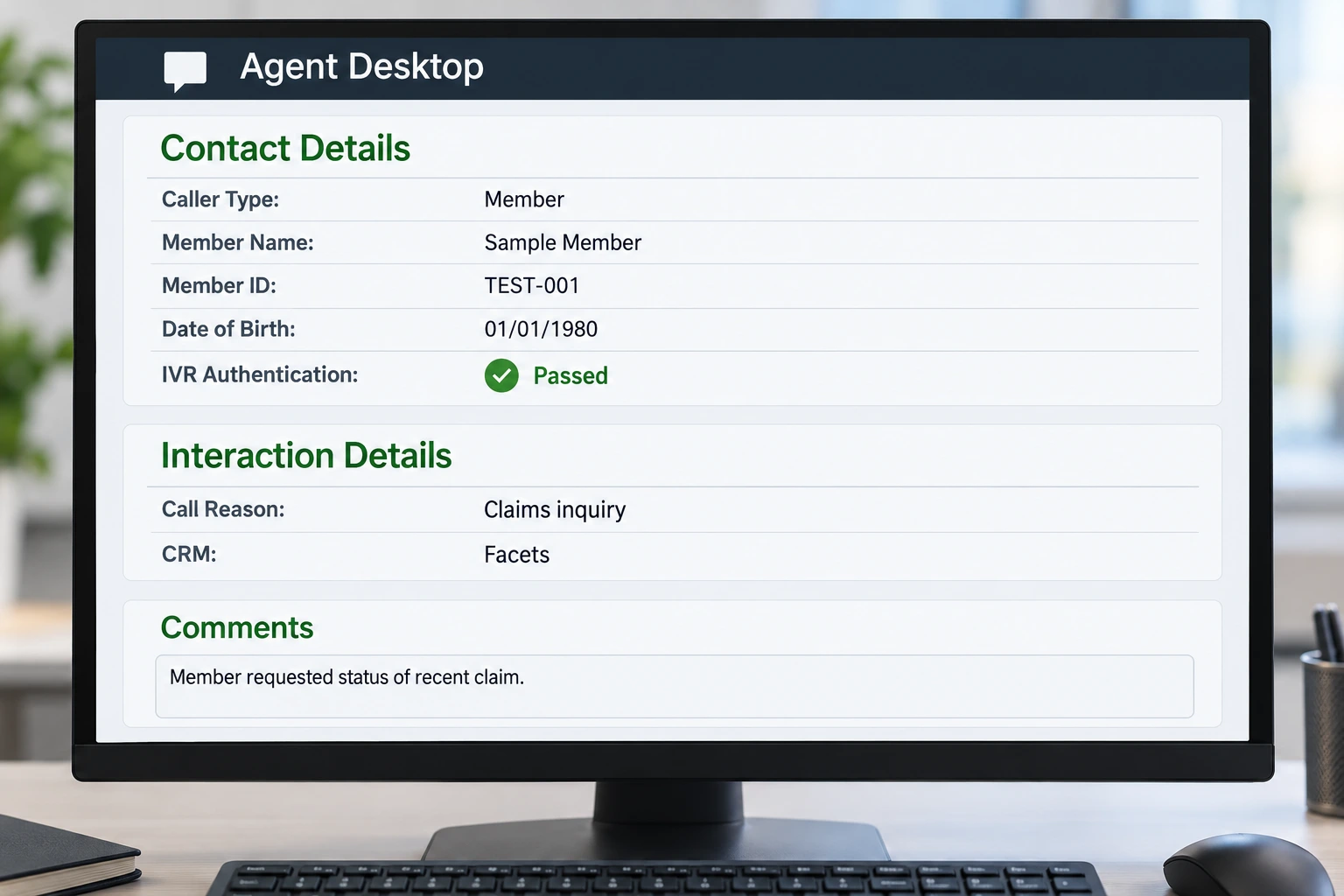
Illustrative agent desktop showing caller details and IVR authentication status.
Illustrative mockup · fictional data
IMPLEMENTED · MEMORIAL HERMANN · 2017

Cisco Finesse Screen Pop & Facets Integration

Led the call center side of an agent desktop integration that carried caller information and IVR authentication status forward to representatives.

Explore the implementation +

The Problem

Members entered their ID in the IVR, but agents could not see it. Asking for it again created repetition and frustration.

My Role & Delivery

I partnered with Cisco leadership and the Memorial Hermann technology and Facets configuration teams. Those technical teams owned integration configuration; I created test cases and participated in after-hours test calls to confirm the information displayed accurately.

Agent Experience

The screen displayed caller details—including member ID, name, date of birth, and IVR authentication status. Agents could use the displayed member ID to retrieve the record in Facets.

Launch & Support

Training prepared agents before production and provided floor support on launch day. CSRs reported discrepancies for investigation.

Observed Outcome

Caller satisfaction improved as members did not have to repeat information. No meaningful AHT reduction was observed.

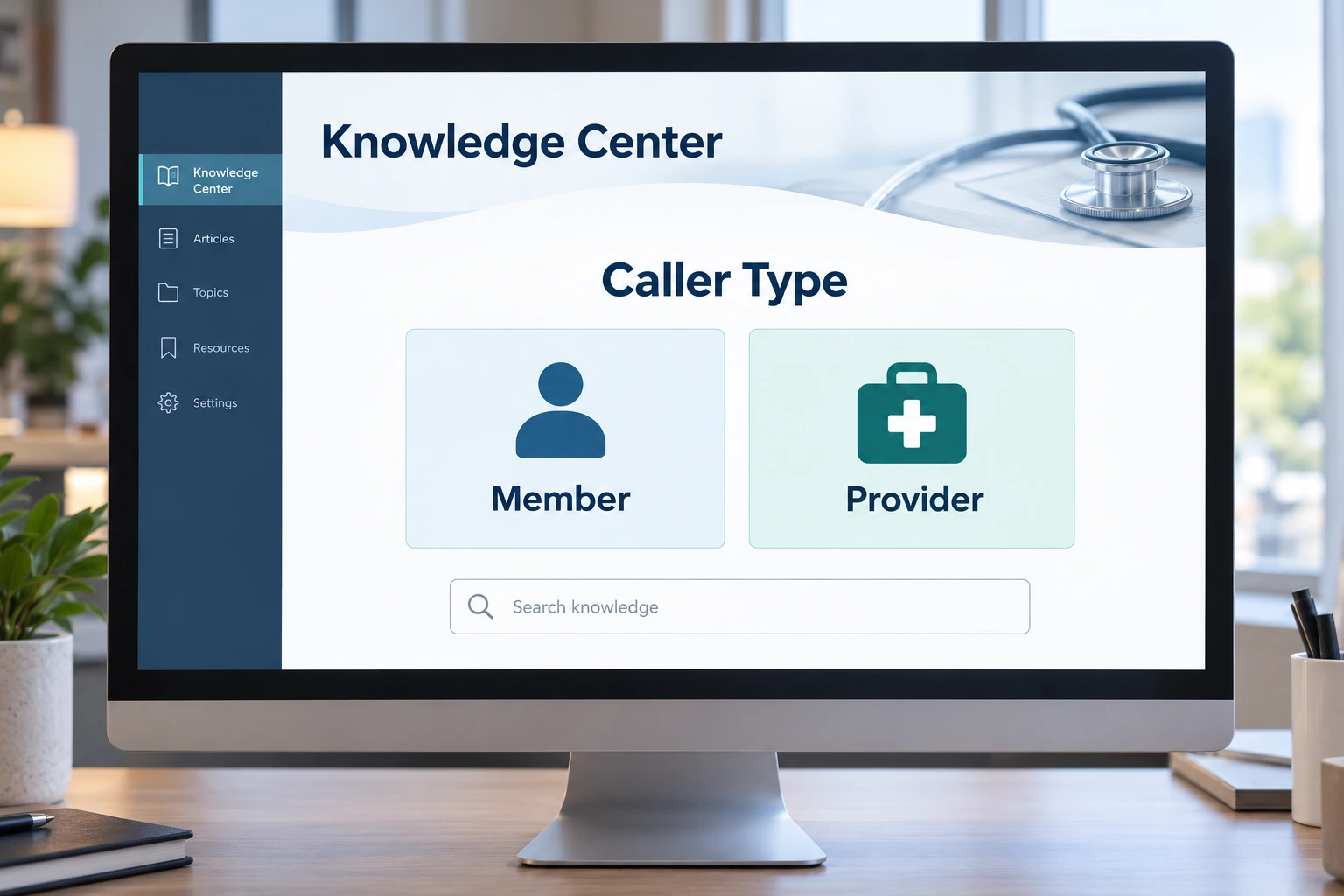
Illustrative knowledge management screen offering Member and Provider caller types.
Illustrative KMS mockup
IMPLEMENTATION & REDESIGN

Knowledge Management: Nanorep & SupportPoint

Led a Nanorep implementation and a later SupportPoint redesign, organizing knowledge around the needs of member and provider service teams.

Nanorep implementation · 2013 +

Requirements & Vendor Selection

The existing KMS lacked customization. I completed the RFP and Business Associate Agreement (BAA), negotiated the contract, and led implementation of a more flexible solution at Universal American.

Design & Content

I designed the experience, wrote most materials alongside a content writer, and tested the system. Agents selected Member or Provider, then browsed topics such as claims, enrollment, and appeals—or searched directly for a job aid. Login updates required acknowledgment, and report email schedules were customized to leaders’ needs.

A Practical Example

An overpayment job aid walked agents through locating the claim, determining whether an overpayment issue applied, and responding to the caller.

Testing, Pilot & Training

Training, QA, supervisors, managers, and CSR subject matter experts tested the system. A broader CSR group then piloted it for two weeks. Four hours of lecture and hands-on training accompanied access provisioning.

Ownership & Outcomes

Two knowledge management analysts maintained the system with operational partners. Agents reported easier searches and welcomed the caller-type navigation and visible updates. Supervisor and lead feedback indicated fewer questions about existing content; no measured percentage is claimed. No substantial AHT improvement was observed. The solution cost less than the previous KMS.

Lesson Learned

Detailed vendor questions about customization and search helped secure a solution that fit both the budget and the service process.

SupportPoint redesign · Scott & White +

The Problem

SupportPoint was already in use, but combined member and provider content made it difficult to find guidance and determine which caller population it applied to.

My Role

I led the redesign with training, QA, knowledge management analysts, a supervisor from each service team, and four CSRs—two from each team. I helped design the materials and look and feel, wrote content, and participated in testing.

What Changed

We created separate Member and Provider databases and updated each CSR’s profile access for their role. A topic-based landing page and search supported navigation. Existing users did not need platform retraining. Knowledge management analysts and trainers maintained content and accuracy.

Reported Results

Overall quality scores increased from 82% to approximately 94%—about 12 percentage points. AHT improved, without a quantified reduction. Internal compliance audits moved from monthly to quarterly.

Planning frameworks & continued learning
PLANNING FRAMEWORK

AI Vendor Evaluation

A structured approach to understanding what a vendor provides, what the organization owns, and where customization and costs have limits.

Explore the framework +

The Problem

An AI purchase can leave unanswered questions about maintenance, configuration, integrations, and ongoing accountability.

My Approach

  • Clarify who owns prompting, updates, testing, and monitoring.
  • Evaluate CRM integration, customization limits, and human handoffs.
  • Compare license and usage pricing, including exclusions and support.

What This Demonstrates

Vendor evaluation, operational requirements, and total-cost thinking grounded in contact center needs.

CONCEPT & CAPACITY PLANNING

Conversational IVR & Agentic AI

Exploring how AI can handle less complex inquiries while supporting accurate information and a clear path to a service representative.

Explore the concept +

The Problem

Routine inquiries consume team capacity, but automation must still meet member needs and handle uncertainty responsibly.

My Approach

  • Use historical call volume and call reasons to estimate eligible demand.
  • Identify appropriate workflows, such as routine claim-status inquiries.
  • Define CRM data dependencies and escalation conditions.
  • Plan monitoring for accuracy, resolution, and human handoff.

What This Demonstrates

Use-case selection, capacity planning, and service design with human support built into the process.

COURSEWORK · IN PROGRESS

AI Workflow Automation

Hands-on learning with Zapier and OpenAI, supported by cloud infrastructure and cost-estimation exercises.

Explore the learning +

The Focus

Understand how an automated workflow connects services and what is required to move from configuration to a working process.

My Approach

  • Configure workflow steps and examine testing requirements.
  • Explore API access, usage costs, and service dependencies.
  • Practice cloud storage and compute sizing for future growth.

Current Status

Coursework and configuration exercises are in progress. No completed production integration or performance results are claimed.

FEATURED IMPLEMENTATION / JOTFORM AI

Tasha AI.
Answers closer to the frontline.

I designed, configured and wrote this internal FAQ assistant for customer service representatives.

The Operational Problem

OneDrive served as the team’s knowledge repository rather than a dedicated knowledge management system. Searching folders for guidance could be challenging and time-consuming, particularly during complex calls.

What I Built

I designed and configured the entire Jotform agent assist and wrote the FAQs using its question-and-answer content section. CSRs could type a question and receive a quick FAQ response.

Testing, Training & Ownership

Two supervisors, one team lead, and two CSRs tested the assistant. Supervisors trained their teams during team meetings, and the team lead was assigned ongoing maintenance.

A Feedback Loop For Better Answers

When an answer was unavailable, leadership received a notification and could add the correct response for future use. Agents also flagged information that needed correction, helping keep the content useful.